





Glossary

- AK – Academic calendar.
- Appeal - procedure carried out to identify and eliminate factors that contributed to the biased assessment of students' knowledge.
- GUK - the main academic building.
- MMC – Mining and Metallurgical Building.
- PRE – distance learning.
- DOT – remote educational technologies.
- DSV – Department of Student Affairs.
- FOR – The Institute Of Basic Education.
- IVD – Institute of Military Affairs


Dear students, in this section you will find the interpretation of all the terms that you will meet during your studies.
- IUP (individual curriculum) - a document reflecting the educational trajectory of a particular student, compiled by the student independently for the academic period on the basis of the Working Curriculum (RUP); contains a list of academic disciplines for which he/she has enrolled, and the number of credits.
- MUK - a small academic building.
- NK – Oil Corps.
- Add/Drop week - a period, usually in the first week of study, when a student can "withdraw" from a discipline and/or enroll in a new one at will.
- Registrar's Office (OR) - a service that registers students for taught disciplines, registers all their academic achievements throughout the entire period of study, provides the organization of boundary and final control of knowledge and calculation of academic rating.
- Office hour - an extra-curricular time when you can ask the teacher to additionally explain something or discuss any issue.
- Prerequisites / post–prerequisites - disciplines that are mandatory for mastering before the discipline being studied / disciplines that are mandatory for mastering after the discipline being studied.
- The proctor - an independent observer from among the staff of the University, responsible for compliance with the rules of the exam.
- Retake – repeated study of the discipline, in case of receiving the final grade "unsatisfactory" "F" – (fail). Re-examination is carried out only on a paid basis.
- Boundary control (certification) - a check of student's academic achievements upon completion of a section (module) of an academic discipline. It is conducted by a teacher of this discipline at the 8th and 15th weeks of training.
- RUP (working curriculum) - a document containing a complete list of academic disciplines of the mandatory component and the elective component, indicating the number of credits, the sequence of studying disciplines, types of training sessions and forms of control.

- Syllabus - a curriculum that includes a description, a summary, as well as the goals and objectives of the discipline being studied; a list of knowledge and skills acquired by the student; topics and duration of each lesson; tasks of independent work; office hours; teacher requirements; criteria for assessing knowledge; work delivery schedule and a list of literature used.
- A transcript - a document of an established form containing a list of completed disciplines for the corresponding period of study, indicating the number of credits, grades and average score. The official transcript, which has a signature and seal, can be obtained at the Registrar's Office (OR), windows 7 and 1.
- An adviser - a teacher who performs the functions of an academic consultant who assists a student in choosing an educational trajectory and mastering an educational program during the entire training period.
- Credit (Credit Hour) - a unit of measurement of the volume of academic work, where 1 credit = 1 academic hour (50 minutes) of classroom contact work of the student per week during the academic period.

- "FX" - an unsatisfactory grade, which means that the exam needs to be retaken.
- The "F" grade (fail) - an unsatisfactory grade, which means that the discipline needs to be re–studied on a paid basis.
- "P" (Pass) - "credited" and "NP" (No Pass) - "not credited". The assessment of the credit is set in the discipline "Physical Culture" and is given during training sessions during the last week of the semester.
- Add/Drop – the period, as a rule, in the first week of training, when the student can withdraw from the discipline and/or enroll in a new one at will. In the first week of the academic period (Add/Drop), the student can change the disciplines, the schedule of classes, and also choose a teacher. Changes to the schedule can only be made through the Registrar's Office. The student must fill out an application for a change in discipline or class time (the application form is posted on the Internet) and submit it to the OR. The application will be reviewed and then, in the absence of overlaps with the existing schedule and a sufficient number of free places in groups, appropriate changes will be made to the student's schedule. At the same time, attending classes according to the existing schedule is strictly mandatory. Applications are considered only during the "Add/Drop" re-registration period.
- GPA - a key indicator of academic performance
Example:

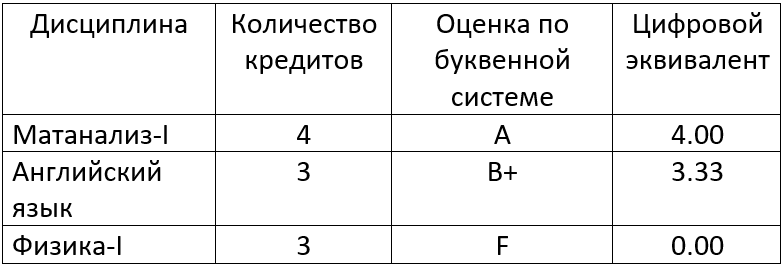
1. Multiply the number of credits of all studied disciplines by the digital equivalent of the assessment:
Matanalysis-I
4 x 4.00 = 16.00
English language
3 x 3.33 = 9.99
Physics-I
3 x 0.00 = 0.00
2. Sum up the resulting values: the final value =16.00+9.99+0.00 =25.99
3. Calculate the total number of credits:4+3+3 = 10
Matanalysis-I
4 x 4.00 = 16.00
English language
3 x 3.33 = 9.99
Physics-I
3 x 0.00 = 0.00
2. Sum up the resulting values: the final value =16.00+9.99+0.00 =25.99
3. Calculate the total number of credits:4+3+3 = 10

Using this formula, you can calculate the semester GPA (total amount and total number of credits for 1 semester) and the annual GPA (total amount and total number of credits for the entire year of study).
The minimum average GPA required for transfer to the next year of study is: 1.6; and the preservation of the state educational grant is: 2.33.
The minimum average GPA required for transfer to the next year of study is: 1.6; and the preservation of the state educational grant is: 2.33.
Дополнительно
Быстрые ссылки
Контакты






To - Do page

Call-центр:
+7 (727) 357 42 42
Деканат ФИТ
+7 (727) 357 42 20
ОР
+7 (727) 357 42 81
+7 (727) 357 42 42
Деканат ФИТ
+7 (727) 357 42 20
ОР
+7 (727) 357 42 81
Made by 1st year students: Larionova Anastasiya, Rinatova Alina, Madenyetova Aliya , Bazargaliyeva Fatima , Maksymkyzy Zhanerke
